I think therefore AI · essay
The Android in the Elevator: Why the Hardest Problem in AI Is the Last 50 Feet
Christophe Pennetier ·
Original publication on LinkedIn ↗
Original cover caption: Generated with Gemini
Words in the original cover illustration
We are living through a strange moment in technology. On the one hand, AI can now augment senior experts with a fluency that feels almost unfair. Give it context, give it scale, give it latency measured in milliseconds, and it starts behaving like a colleague who never sleeps and never forgets.
On the other hand, the more we push AI toward action — real action, not demos or student projects — the more we confront a paradox: the systems we build look increasingly like us.
This is not science fiction. It is ergonomics. Human beings built the world for humans. Our data is human. Our workflows, our mistakes, our shortcuts, our tacit knowledge: all human. It would be bizarre if our agents were not anthropomorphic. We built androids because the world they must operate in is, quite literally, anthropocentric.
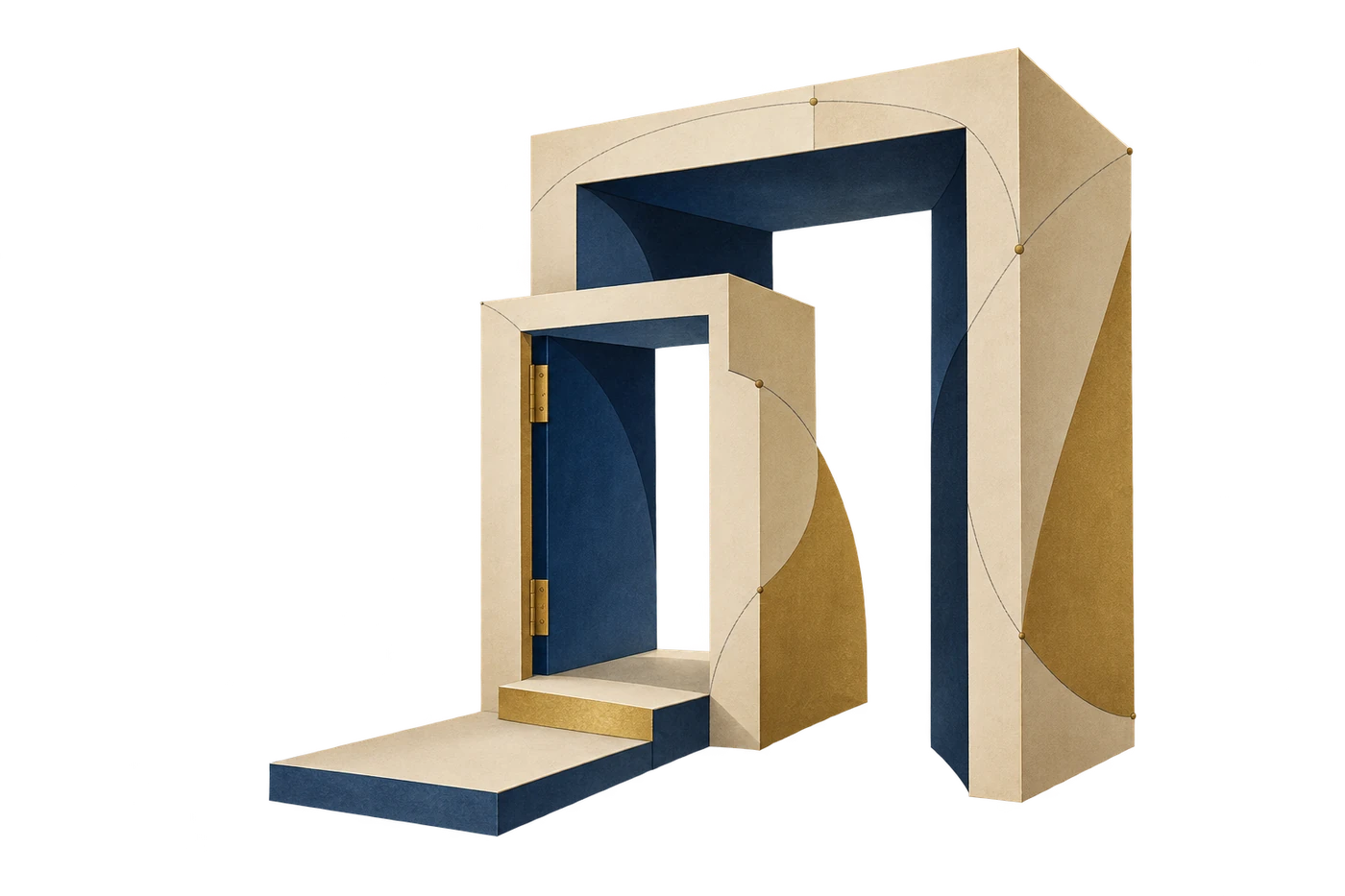
And yet, this creates a new frontier. The hardest part of delivery is no longer the “last mile.” It is the last 50 feet. A robot can navigate across a city, but how does it press the right elevator button? How does it find the apartment door with the peeling sticker and the broken buzzer? This is the frontier that forces us to ask new questions, not about intelligence, but about embodiment.
This is why I defend anthropomorphism in AI. Because Don Norman was right about affordances: people understand what looks familiar. “AI agent” is esoteric; “a teammate with a role, a job description, and guardrails” is not. When we give an agent a function, a profile, a “place” in the org chart, something interesting happens: humans finally know how to collaborate with it.
But there is a shadow on the wall.
Humans make mistakes. Agents will make mistakes too. And when they do, the errors won’t stay local — they’ll propagate at AI scale.
So what prevents catastrophe?
We like to talk about explainability. Not the “read the weights” kind, but the higher-level, architectural kind — mixture of experts, chain-of-thought, tree-of-thoughts. Mechanisms that give us visibility into actions, not neurons. This helps.
We like to talk about guardrails. Treat them exactly as you treat the other teammates you manage. Clear roles. Clear boundaries. Clear escalation paths. As I argue in Silicon Soulmate, working with AI agents forces you to rediscover management in its purest form — expectation-setting, oversight, reversibility.
Ah, reversibility. The hardest principle of all. With humans, we undo. We regroup. We reset. With agents, when you overshoot, you sometimes lose the trail. Stochasticity is a wonderful engine for creativity, but a terrible companion when you need to return to a known state.
So here is my open question — not a conclusion. As we hurtle toward agentic AI at scale, where mistakes propagate like electrical arcs, how do we preserve the human virtues that matter most: reversibility, accountability, reflection?
AI can act. AI can help. AI can amplify.
But once it starts acting like us — truly like us — how do we make sure it also errs like us: slowly, recoverably, humanly?
The answer, I suspect, will define the next decade.