I think therefore AI · op-ed
The Ouroboros Protocol
Christophe Pennetier ·
Original publication on LinkedIn ↗
Original cover caption: Generated with Gemini
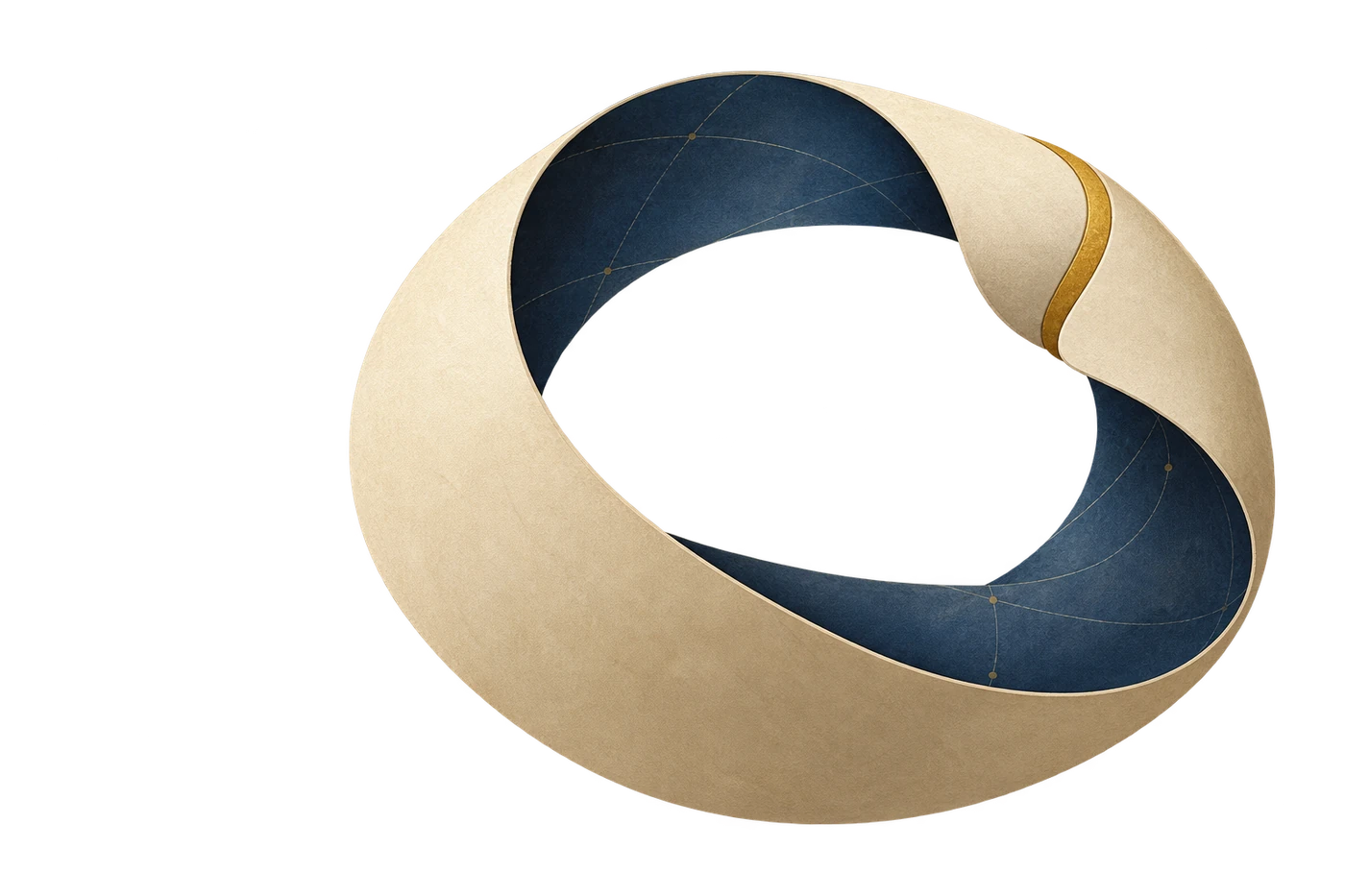
Words in the original cover illustration
How AI Started Rewiring Its Own Brain
This morning, a quiet AI lab in Palo Alto raised a $300 million Series A at a $4 billion valuation.
No product. No app. No customers. What they sold was a loop.
Ricursive Intelligence didn’t pitch a better chip. They pitched something more unsettling: AI that designs the chips future AI will run on. Not metaphorically. Literally.
With AlphaChip, and now their new engine, they showed that once transistors shrink below a few nanometers, human intuition collapses. At that scale, physics stops behaving like logic and starts behaving like weather.
Humans don’t design weather. We model it.
AI doesn’t “see” the fog of the nano-scale as chaos. It sees a high-dimensional optimization problem. And it wins.
This is the Ouroboros moment:
AI designs a faster chip. That chip trains a better AI. That AI designs an even faster chip. We’ve stepped onto a recursive curve. But here’s the part most people miss. A recursive chip is useless if it’s running an operating system from 1995.
If AI designs the substrate, it must also design the language that speaks to it. Today, we force alien, hyper-parallel silicon to understand human abstractions like C++, Python, CUDA.
That’s not optimization. That’s translation loss.
The future isn’t “AI chips.” It’s a triangle:
- The Chip: AI-designed silicon, optimized for physics, not readability.
- The Language: Not written by humans. Generated by AI, tuned to that specific chip.
- The OS: Not a resource manager, but a self-correcting loop.
In that world, the OS doesn’t just run applications. It adapts.
If you’re a video editor, it notices where time is lost, rewrites its scheduler, recompiles drivers, and quietly becomes a video OS. Overnight.
This is why Apple suddenly matters again.
Publicly, Siri is a joke. Privately, Apple has spent a decade putting a brain in your pocket. Context lives on the device. Latency collapses to zero. The OS already owns your habits, your sensors, your life. Apple isn’t building a smarter chatbot.
They’re building an intelligence that lives inside your environment.
Google sees this too. They’re playing the same game, but at planetary scale: chips, models, compilers, operating systems, even physics. This isn’t a fight over AI features. It’s a fight over who controls the loop.
The real moonshot isn’t AGI. It’s something quieter. Software that is written for a moment, executed perfectly, then disappears. Languages no human ever reads. Chips that reconfigure themselves depending on what you’re doing.
In that world, humans don’t write code. We define intent. We set constraints. We conduct.
The $300 million wasn’t an investment in a startup. It was a signal that engineering is changing hands.
The machines are beginning to build the machines.
The only remaining question is whether we learn to orchestrate the loop, or stay stuck trying to read the sheet music.