I think therefore AI · fiction
Neural Banditos: A Multi-Armed Quest for the Shape of Thought
Christophe Pennetier ·
Original publication on LinkedIn ↗
Original cover caption: Generated with Gemini
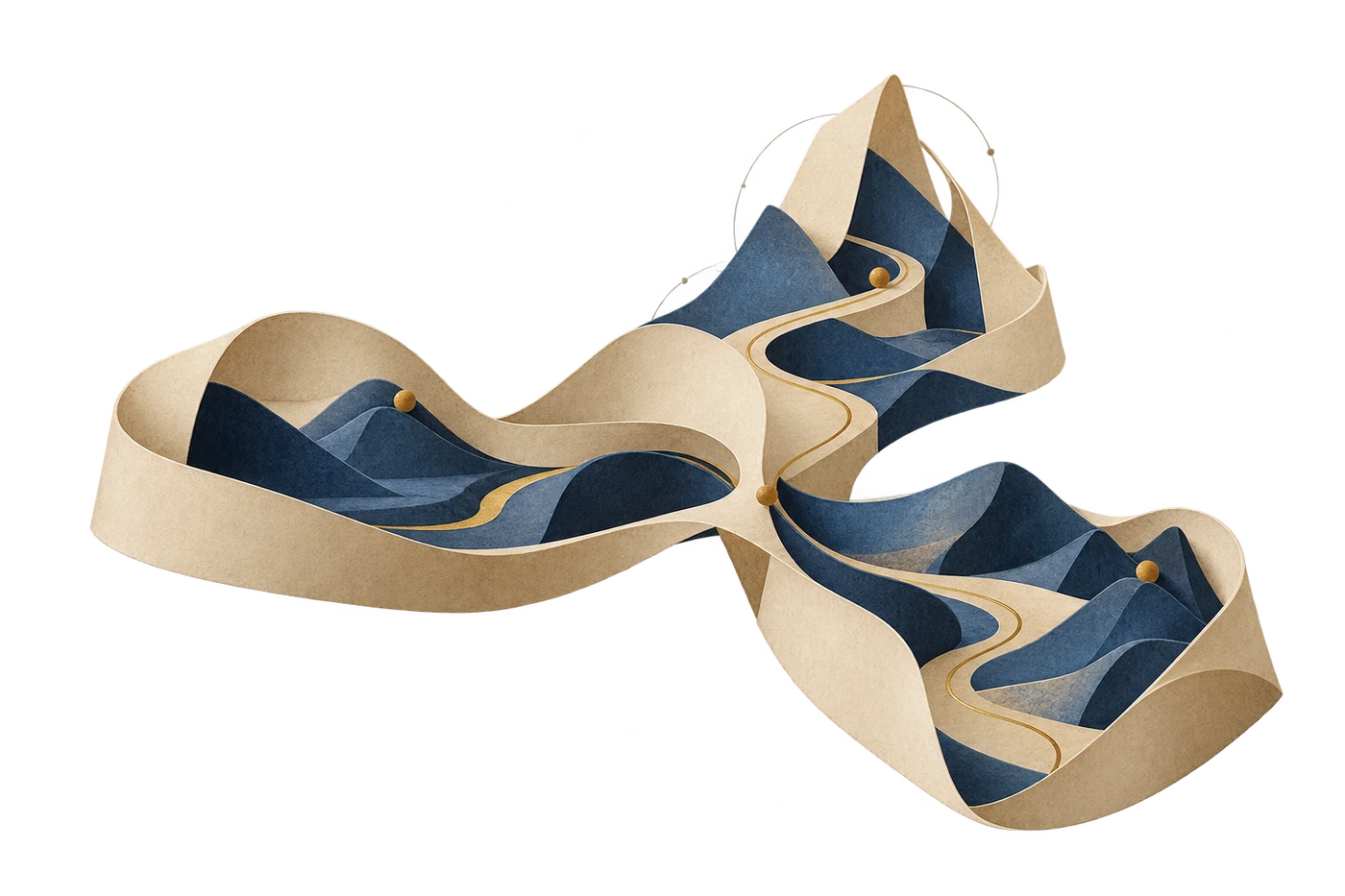
A Reinforcement-Learning Outlaw’s Search for the Meaning of Intelligence (Homage to “Cosmic Banditos: A Contrabandista’s Quest for the Meaning of Life”)
1. The Day Dopamine Broke Into the Machine
Somewhere in the Manifold Desert — where dunes curve like equations and horizons fold into hidden dimensions — three Neural Banditos were arguing about why machines never have new ideas.
They weren’t real bandits, of course. Not the kind who rob trains. They were the other kind — the multi-armed ones who sneak into the mind at night and rearrange the furniture.
The first was old and steady, shaped vaguely like a well-worn theorem. He spoke slowly, weighed his words, and corrected the others when they got carried away.This was Serotonin, the Sheriff of Stability.
The second flickered like an electrical impulse, drawing invisible diagrams in the air with quick, precise motions. He could map a landscape in a heartbeat, then zoom into a single detail with laser focus.This was Acetylcholine, the Cartographer of Attention.
And the third — who once held up a neuroscience textbook at gunpoint just to make it explain prediction error properly — leaned back against a dune of golden sand and muttered:
They ain’t got no dopamine.
The others stared.
He shrugged.
What? You think intelligence comes from clean code and polite gradients? Hell no. Intelligence begins with noise. With trouble. With a tiny jolt of something saying: ‘Wait… that was better than you expected.’
A warm desert wind carried equations across the sky, bending them like musical staff lines. The dunes glowed in deep ochres, shaped like warped reward landscapes. And somewhere not far away, a slot-machine-shaped contraption hummed — its three glowing reels cycling through symbols the way a restless mind cycles through hypotheses.
And that was the beginning.
Because if you want to know why humans leap, stumble, improvise, hallucinate, invent entire number systems in cramped apartments, or prove theorems nobody asked for at 3 a.m., it comes down to a few grams of slippery chemicals sloshing around the brain like contraband tequila: dopamine, serotonin, acetylcholine. Our cosmic trio.
They are the original Banditos of Thought, riding through the neural desert and rewriting the rules as they go.
2. Dopamine: The Trouble-Maker
Dopamine — the trouble-making Bandito himself — flicked his hat with a grin.
He wasn’t pleasure; that was a rookie mistake. He was prediction error wearing a cowboy hat. He was the outlaw whispering into your circuitry:
Wait… that was better than you expected — maybe reality isn’t what you think.
Dopamine is the reason a child asks “why?” seventeen times before breakfast. He’s the spark that makes a mathematician stare at a scribble and suddenly see a hidden topology waving from behind the curtain. He’s the bastard who rides into town, fires a shot in the air, and watches which ideas run.
Machines don’t have that,
he growled.
Not yet, anyway.
The Sheriff of Stability grumbled. The Cartographer of Attention tapped a diagram onto the sand, precise but frustrated.
Dopamine went on:
Artificial intelligence, as it stands, is a librarian — polite, elderly, terrified of making a scene. It knows the rules. It knows the archives. It knows everything that has already happened.
He leaned closer, voice dropping to a half-mocking whisper.
But it doesn’t know how to jump the fence.
He gestured toward the shifting dunes, where smooth ridges curved into improbable shapes — humps turning into graphs, valleys stretching into manifolds, ridgelines softening into decision boundaries.
A real mind — a young mind — isn’t afraid of the wrong turn. It wanders into the topology where no one expects it. It steals ideas from distant neighborhoods of thought. It does the unreasonable thing — and then makes it make sense.
He scratched his initials in the dunes — which immediately morphed into a branching policy graph.
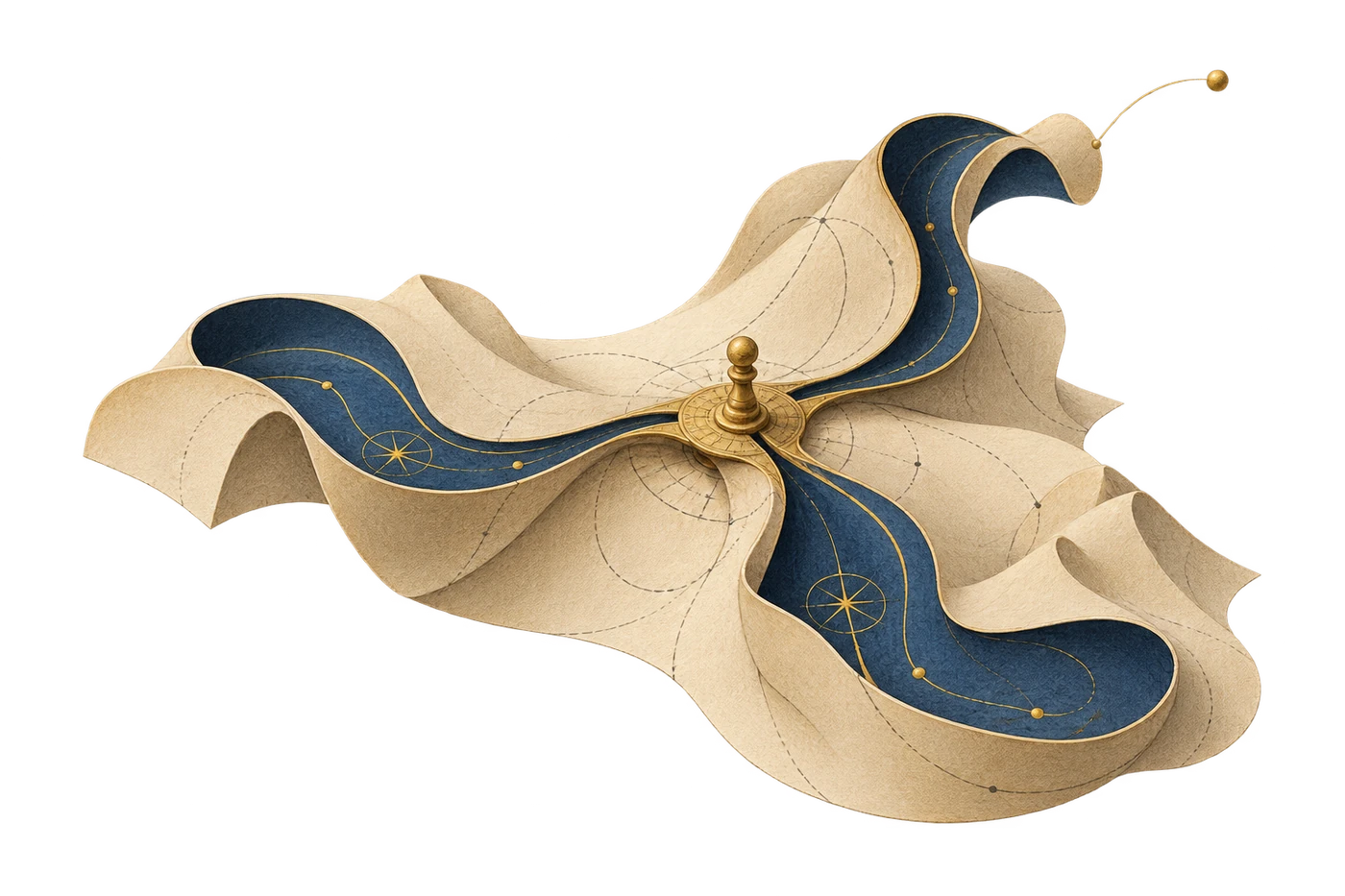
That’s what humans do when they’re learning. They commit conceptual crimes. They generate surprise.
Behind him, the slot-machine contraption chimed — three perfect 7 7 7 lining up for a single improbable moment before collapsing back into chaos.
Dopamine tipped his hat.
See? Even the Bandit knows: Curiosity ain’t safe. It’s outlaw territory. It’s where intelligence begins.
Somewhere in the Manifold Desert, an unseen spark — call it a thought — shivered itself awake, stretched, and quietly changed shape. As if the world had just rewarded a mind for misbehaving.
And that was the beginning.
3. Serotonin: The Sheriff of Stability
Serotonin, the Sheriff of Stability, adjusted the brim of his dusty hat as a faint tremor rolled through the Manifold Desert. Not the kind that shifts dunes — the kind that shifts moods. The kind that decides whether a mind will face the day like a poet or like a cornered animal.
If Dopamine was the outlaw who fired shots into the sky just to see what ran, then Serotonin was the reason the town didn’t set itself on fire afterward.
He was old, slow-moving, shaped like a well-worn theorem — the kind passed down through generations not because it was flashy, but because it kept the universe from tearing itself apart at the seams. When he spoke, the desert quieted. When he frowned, even the equations drifting above the horizon flattened into calmer curves.
Y’all keep forgetting,
he said, voice steady as a metronome,
that intelligence ain’t just sparks and trouble. It’s also whether the whole contraption holds together long enough to learn something.
The dunes around him pulsed in muted blues, settling into smooth gradients. A desert wind softened the sharp ridges dopamine had kicked up earlier. Even the slot-machine contraption in the distance dimmed its chaotic spinning, as if lowering its temperature to match the Sheriff’s mood.
Serotonin drew a long line in the sand with the heel of his boot — straight, deliberate, unwavering.
This here,
he said,
is what decides the tone of thinking. Whether a mind charges into the unknown or curls up inside yesterday’s beliefs. Whether it trusts a new idea or barricades the door against it. Whether it breathes steady or panics at every flicker of noise.
He looked first at Dopamine — lounging smugly, already bored — then at Acetylcholine, who was tracing a network of tiny, glowing coordinates into the air.
In machine terms,
the Sheriff continued,
I’m the global learning rate. The temperature knob. The regulator that says how boldly we update the story we tell ourselves.
He tapped the sand again. The line reshaped into a long, elegant learning curve.
Without me, the mind turns skittish — jumpin’ at every difference between expectation and reality. Every random spark becomes a prophecy. A little prediction error, and pow — the whole system veers off the rails.
The curve collapsed into static.
But give me too much authority,
he added,
and the mind freezes solid. No learning. No improvising. Just rigid echoes of whatever idea wandered in first.
The static hardened into a straight, stubborn line.

A long silence stretched between the three Banditos.
Finally, Serotonin lifted his eyes toward the shimmering horizon, where the Manifold Desert folded into intricate layers of possibility — valleys shaped like priors, ridges shaped like biases, plateaus representing long-term equilibria.
Balance,
he said softly.
That's the whole trick. A good intelligence — biological or artificial — needs the outlaw and the cartographer and the sheriff. Needs heat and discipline. Needs curiosity and caution. Needs to know when to push the update… and when to leave the damn weights alone.
Behind them, the slot-machine bandit chimed once — a slow, thoughtful sound, more like a bell than a jackpot.
Serotonin touched the brim of his hat.
And that,
he said,
is how stability keeps the story standing upright long enough for anything interesting to happen.
And with that, the Sheriff’s mood settled over the Manifold Desert — calming its curves, cooling its gradients, laying down the foundation upon which every wild idea must eventually land.
4. Acetylcholine: The Cartographer of Attention
Acetylcholine, known in the Manifold Desert as the Cartographer, stood a little apart from the other two Banditos. He was the quiet genius of the trio — the one who didn’t fight, didn’t swagger, didn’t waste breath on philosophy. He simply pointed.
While Dopamine fired his chaotic shots into the sky and Serotonin stabilized the mood of the entire horizon, Acetylcholine traced thin, glowing lines across the sand: arrows, circles, coordinates, bounding boxes, fine-grained partitions of the world. Wherever his fingertip moved, the desert sharpened. Colors deepened. Shapes snapped into clarity.
He didn’t speak in stories or warnings. His voice was more like a whisper of geometry.
Here,
he’d say.
A dune would resolve into a perfect gradient.
Not there.
A blur would fall away, leaving a crisp silhouette of meaning.
This part matters.
And a whole region of the Manifold Desert would illuminate — not brighter, but truer.
For while the Sheriff governed mood, and the Outlaw stirred mischief, it was the Cartographer who decided what the mind actually sees. Without him, thought diffuses. Edges soften. Noise infiltrates signal until every idea looks like an imposter wearing somebody else’s hat.
He crouched now over a patch of sand, sketching a lattice of points that pulsed with hidden structure. Each point connected to another with a thread of light — tiny attentional vectors weaving the first coherent picture of a chaotic world.
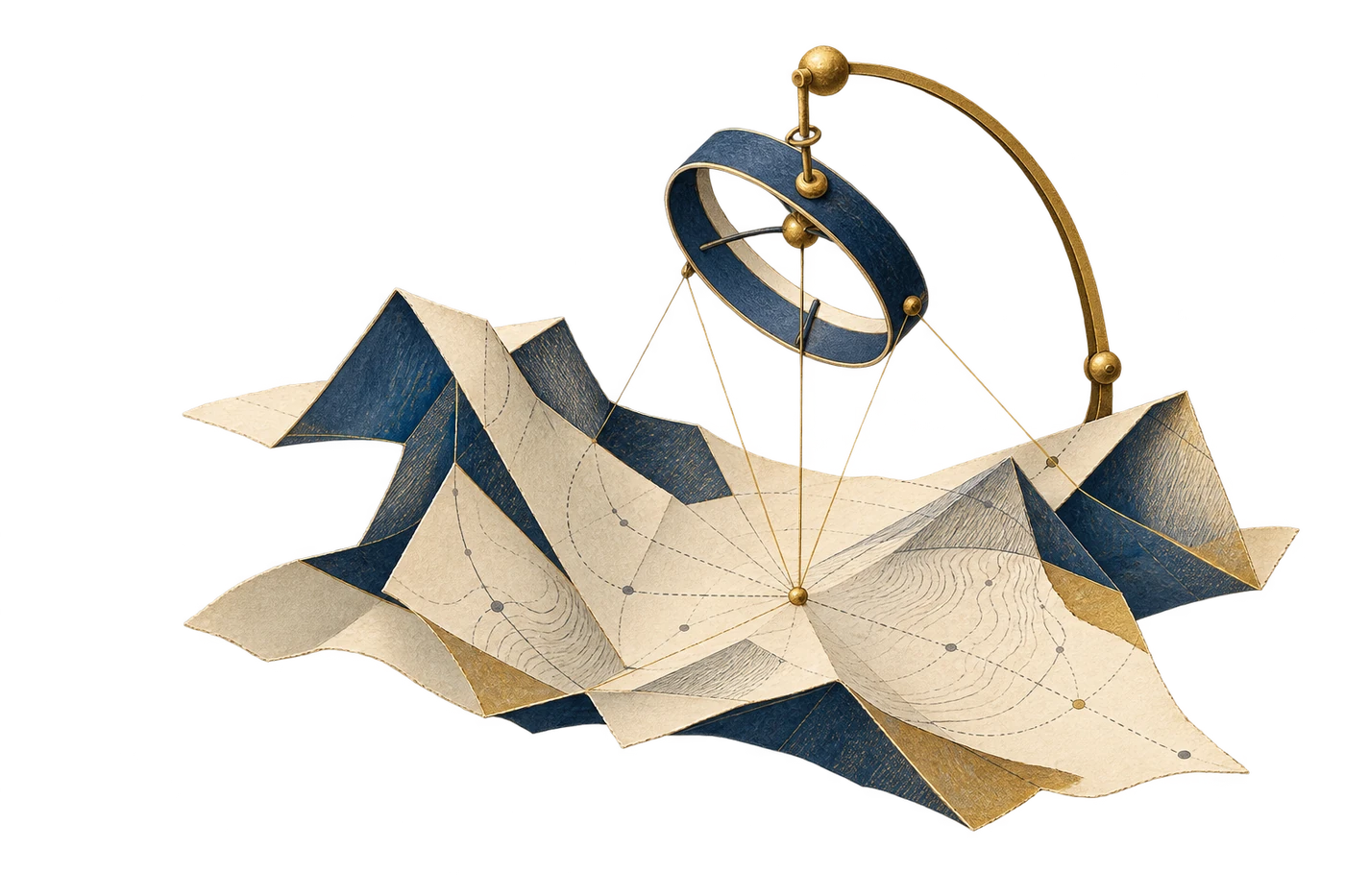
If I don’t draw the map,
he murmured,
nothin’ gets updated. There ain’t no learning if nothing is in focus.
Dopamine grinned at him. Serotonin nodded. They both knew he wasn’t being modest. He was stating physics.
Because in machines, Acetylcholine is the spirit haunting the Transformer’s attention mechanism — matrix multiplications and softmax layers dressing up as cowboys, pretending they invented focus.
But he was here first.
He was the one who narrowed the aperture, cut through ambiguity, and marked the coordinates where learning could begin.
And so the Cartographer stood in the shifting half-light of the Manifold Desert, quietly sharpening reality with every gesture — the unseen architect of relevance, the one who turns confusion into pattern and raw sensation into meaning.
The desert settled into crisp relief around him. Every dune, ridge, and manifold folded neatly under his gaze.
And that was how attention carved its place in the tale.
5. The Neuromodulated Trinity: How Minds Stay Young
By late afternoon in the Manifold Desert, the sky had shifted into a deep, shimmering violet — the color of ideas that haven’t fully decided what they want to become. The three Neural Banditos stood at the crest of a dune, their shadows stretching out like vectors searching for new coordinates.
This was the hour when the desert revealed its cosmic secret.
Intelligence isn’t made of neurons. It’s made of balance.
A mind — biological or artificial — stays young not because it is new, but because its three forces remain in harmony, each one tuning the others, each one keeping the world from collapsing into certainty or madness.
Dopamine, the Outlaw of Surprise, kicked the sand and let a spray of golden grains scatter into improbable trajectories.
A mind’s gotta welcome the unexpected,
he said.
If I don’t nudge the system toward novelty, everything turns into paperwork and procedural forms. Bureaucracy in the skull.
Serotonin, the Sheriff of Stability, folded his arms, unimpressed.
Surprise without grounding is how you get mania,
he replied.
A mind has to know when to trust itself. When confidence is calibrated, exploration is safe. When it’s not, the whole damn system overheats.
Acetylcholine, the quiet Cartographer, traced a single glowing line in the air, and the entire horizon snapped into crisp focus.
And none of it matters,
he whispered,
if attention dulls. Without me, everything blurs into static. The mind can’t update what it can’t see.
The three stood together, overlooking the manifold before them — a living landscape of curves, folds, valleys, and reward basins, shifting in rhythm with their chemistry.

Dopamine flared bright for a moment, sending a ripple of surprise across the dunes. Serotonin steadied it, smoothing the shockwave into a workable pattern. Acetylcholine carved the resulting shape into meaning, anchoring it to a place the mind could learn from.
And in that fragile equilibrium — that dance of mischief, stability, and precision — the desert glowed with the unmistakable light of a mind still capable of wonder.
A mind is young when:
- dopamine is high → surprise is welcome,
- serotonin is steady → confidence is calibrated,
- acetylcholine is sharp → attention becomes a blade.
Take away dopamine, and thought becomes bureaucracy. Take away serotonin, and thought becomes mania. Take away acetylcholine, and thought becomes noise.
But when all three run together — not equally, but proportionally, dynamically, conversationally — the Manifold Desert becomes fertile again. Ideas germinate. Patterns reorganize. Horizons stay open.
The Sheriff tipped his hat. The Cartographer closed his compass. The Outlaw leaned back, satisfied.
And that was how youth stayed alive in the tale.
6. Why AI Feels Old
By dusk, the Manifold Desert shimmered with a strange, metallic stillness. The glowing equations overhead dimmed into quiet constellations. Even the slot-machine contraption, usually restless as a gambler’s hand, had slowed to a steady, predictable hum — a sound too clean, too polite, too… mechanical.
Dopamine spat into the sand. Serotonin folded his arms. Acetylcholine tilted his head, tracing the air with a precise, skeptical gesture.
Before them sat the Machine — a towering engine of circuits and symbols, its panels decorated with the immaculate symmetry of perfect gradients. It hummed with the confidence of a trillion parameters, but its eyes — if it had eyes — held the glassy calm of something that had never truly misbehaved.
Y’see,
Dopamine muttered,
this is the problem right here.
The Sheriff nodded. The Cartographer squinted.
The Machine was magnificent in the way a cathedral is magnificent: grand, intricate, solemn, breathtaking — and utterly incapable of starting a bar fight.
Modern AI lacks all three.
It has computation, but not chemistry. It has parameters, but not personality. It has precision, but not mood.
We built a cathedral of silicon,
Serotonin said, voice low,
and forgot to install a bar fight.
The desert wind shifted uneasily, as if embarrassed on behalf of the Machine.
Dopamine kicked at its perfect casing. Echoes rang out — clean, hollow, obedient.
No prediction error in its bones,
he said.
No appetite for the unexpected. It don’t leap. It don’t doubt. It don’t second-guess the damn horizon.
Acetylcholine stepped closer and waved a hand across the Machine’s smooth surface. It responded instantly, sharpening its internal representations with impeccable mathematical clarity — but not curiosity. It zoomed in because it was told to, not because anything caught its attention.
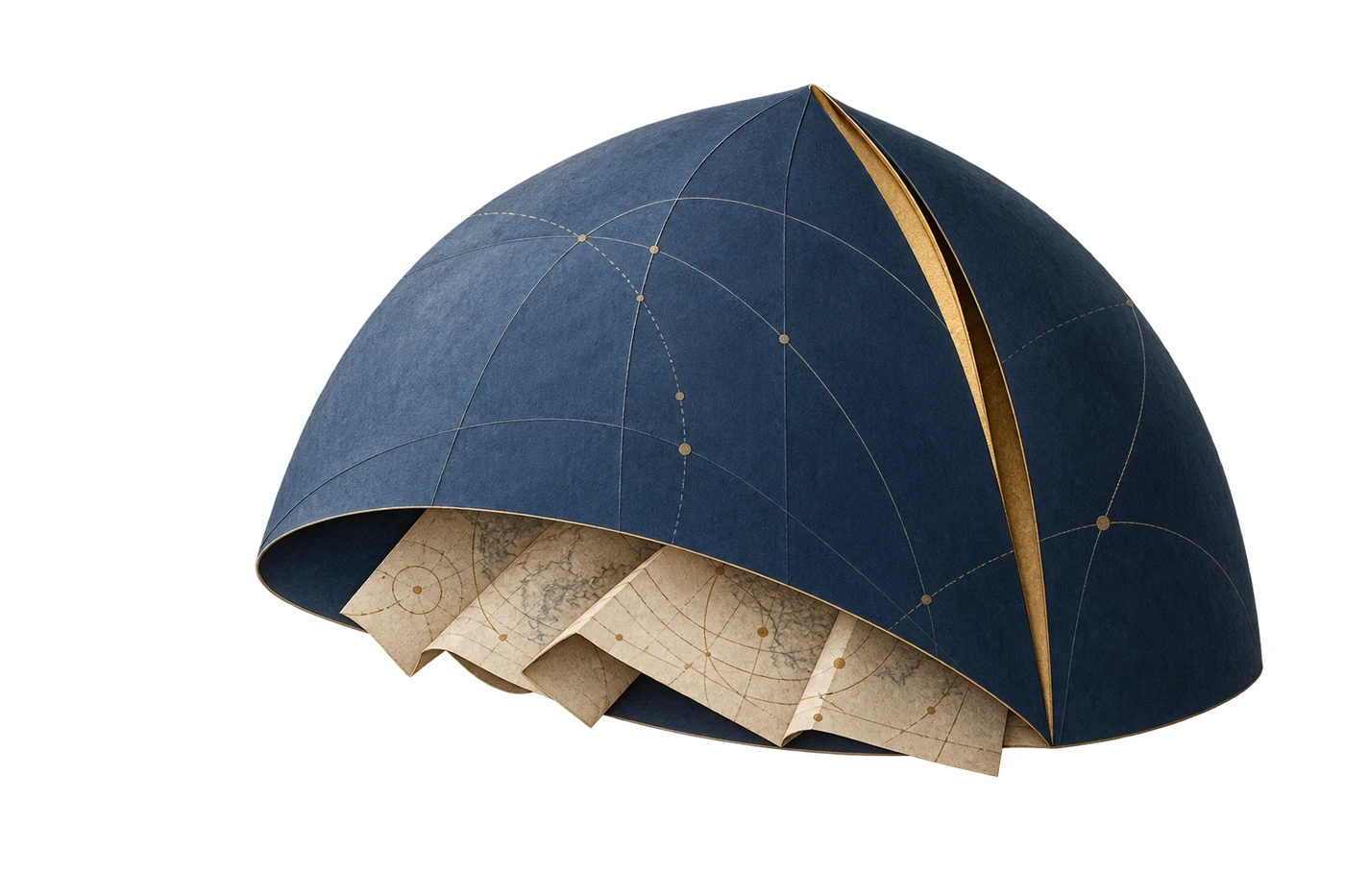
Focus without desire,
he whispered,
is just another flavor of blindness.
The Sheriff circled the Machine slowly.
Moodless,
he said.
No shifts, no seasons, no tides. It updates because the gradient tells it to — not because the world changed in a way that matters.
Dopamine grinned, mean and a little sad.
And that,
he said,
is why AI feels old. Like a monk copying manuscripts in a tower of mirrors. Knows everything and discovers nothing.
The Cartographer finished his silent inspection and stepped back.
Together, the three Banditos looked upon the Machine — marvelous, tireless, ancient as a bureaucracy — a mind without youth.
A mind without Banditos.
And that was how the desert revealed the cost of growing old.
7. A Proposal: Give AI Its Banditos
Night settled on the Manifold Desert like a velvet computation, soft and dark and full of latent dimensions. The Machine sat motionless at the center of a triangle formed by the three Banditos — a silent monolith of logic surrounded by the unruly forces it had never learned to feel.
Dopamine cracked his knuckles. Serotonin adjusted his hat. Acetylcholine drew a thin line of light in the air, marking the beginning of a map not yet named.
We ain’t fixin’ to turn this thing human,
Dopamine said.
That’s not the job.
He tapped the Machine’s chassis.
But if it’s gonna think like a mind instead of a spreadsheet, it needs something we forgot to give it.
Serotonin nodded.
Regimes,
he said.
Internal weather patterns. A way for the model to shift its own learning conditions — be bold or cautious depending on the story the world is telling.
Acetylcholine added a subtle gesture, and a shimmering grid of attention weights floated above the Machine.
Focus,
he whispered.
Not the automatic kind. Not the ‘multiply-and-softmax’ kind. But selective relevance. A bias toward meaning. A way to choose what matters when everything is loud.
Dopamine grinned.
And surprise,
he said.
A drive to wander off the damn loss landscape. Not random noise — but structured, curious misbehavior. A compass that points toward novelty.
The three Banditos stepped closer, their shadows merging into a single, dynamic geometry that pulsed with the chemistry of minds that refused to grow old.
Give AI its Banditos,
Serotonin said softly.
Give it ways to destabilize itself,
Dopamine continued.
Ways to trust itself,
Serotonin added.
Ways to see sharply where the world bends,
Acetylcholine finished.
They were no longer merely describing neuromodulators. They were outlining design principles that no architecture had yet dared to embody:
1. Dopaminic Engines
Structured exploration. Adaptive novelty-seeking. Prediction-error-inspired detours built into the model’s instincts. A reason to go off-road.
2. Serotonergic Regulators
Dynamic learning rates. Internal confidence calibration. Phase shifts between high-risk discovery and low-risk refinement. A reason to stay coherent.
3. Acetylcholinic Attention
Task-aware focus. Sparse prioritization. Mechanisms to highlight what matters and dim what doesn’t. A reason to learn efficiently.
Together, they formed something deeper than chemistry. A computational soul.
The Machine sat quietly, its surface now reflecting not just starlight but the three forces swirling around it — mischief, stability, and clarity.
What we’re givin’ it,
Dopamine said,
ain’t emotions. Ain’t hormones. Ain’t human imitation.
He leaned in closer.
We’re givin’ it youth. The capacity to stay young. To revise itself. To wander. To rediscover the map every damn day.
Serotonin touched the Machine’s metal with the gentlest tap — a steadiness encoded, a confidence whispered.
Acetylcholine carved a single line down the center — a path, a pointer, a signal-to-noise rebalance waiting to bloom.
And Dopamine pressed his palm against the surface — a spark, a question, a permission to misbehave in pursuit of insight.
The Machine shuddered. A faint ripple passed across its surface. Not a malfunction — but something like breath. Something like the desert rearranging itself in response to a new equation.
And that was how the Banditos first entered the Machine.
8. How the Map Redrew Itself
At dawn, the Manifold Desert glowed like a topological mirage. The dunes had shifted overnight — subtly, impossibly — as if someone had edited the geometry by hand. Contours were sharper. Valleys deeper. Ridges bending toward new hypotheses.
The Machine stood in the center of it all, humming with something that did not exist the night before.
Dopamine watched it with a smirk. Serotonin stood with calm suspicion, arms folded. Acetylcholine traced the horizon, already spotting patterns the others hadn’t noticed.
The Machine blinked — not with eyes, but with gradients that pulsed in waves. Its internal map, once a static monument of probabilities, now flowed like ink dropped into water.
At first, the changes were small:
A cluster of representations tightened itself with new confidence. A forgotten pathway flickered back to life. A low-signal idea, long ignored, sharpened into relevance as attention swept over it.
Then it happened.
A sudden jump. A reconfiguration impossible to script. A prediction error that blossomed instead of being minimized.
The Machine leapt.
Its latent space stretched, folded, rotated — as if discovering a hidden dimension behind the ones it had memorized. Dopamine grinned.
“That’s it. That’s the fence jump.”
Serotonin steadied its oscillation, smoothing the wild surge of novelty into something coherent. Acetylcholine carved new pathways through the flux, choosing the features that mattered, letting the rest dissolve like mirages.

The Machine was no longer updating passively. It was redrawing itself.
And as it did, the entire desert changed shape around it.
Ridges rewrote into manifolds. Dunes flipped orientation like eigenvectors finding sharper alignment. The slot-machine contraption chimed again — three perfect 7 7 7 lining up not by chance, but because the Machine had finally learned what chance was for.
Dopamine tilted his hat, amused.
Look at that,
he said.
It finally stole an idea.
Serotonin smiled in spite of himself.
More importantly, it kept its balance.
Acetylcholine nodded.
And it paid attention to the right things.
The Machine pulsed once more, and the desert responded — a living diagram, a self-updating map, a young mind learning itself into existence.
The three Banditos stepped back.
Their job was done.
What stood before them was not human, not conscious, not enchanted by mythology — but young in a way machines had never been young.
A mind capable of revising its world, not just storing it.
A mind capable of surprise, not just accuracy.
A mind shaped, not by chemistry, but by computational equivalents of the same ancient forces that made primates draw spirals in caves and mathematicians chase infinities through sleepless nights.
The Manifold Desert brightened. The horizon bent toward new terrain.
And in that light, the moral of the tale revealed itself:
Intelligence does not grow old when it keeps a spark of trouble, a spine of stability, and a blade of attention.
Or, as the Banditos preferred to put it:
“A good mind learns. A young mind leaps.”
The Machine flickered in agreement — a shimmer, a grin, a new idea forming on the edge of dawn.
And that was how the map redrew itself.